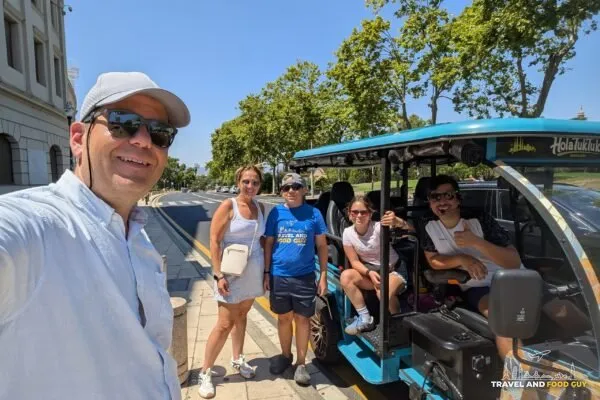
We walked into El Call on the fifth of August, late in the afternoon, and we came on purpose. The Gothic Quarter and the Jewish Quarter were the part of Barcelona we had not seen yet, and at the end of our tuk tuk tour that morning we asked Leo for two things. Drop us here. And tell us where to eat. He sent us to Tapas San Miguel, a few minutes away, and we walked into El Call straight off the back of lunch.
A while later we were standing in front of an information board inside the Sinagoga Major, reading that on the fifth of August in the year 1391 this quarter was attacked and set on fire.
That part nobody planned. We picked the quarter. The date was pure accident. But it changes how you walk a place, standing in it on the anniversary of the worst thing that ever happened in it, six hundred and thirty five years later to the day.
This is one of the oldest corners of Barcelona and it sits two streets behind the cathedral. It is easy to walk straight over the top of it on the way to somewhere with a queue.
Updated August 2026. Nothing is sponsored, and nothing was comped.
Where Is the Jewish Quarter in Barcelona?
El Call is a small block of lanes in the Barri Gotic, bounded roughly by Carrer del Call and Carrer dels Banys Nous, with Placa Sant Jaume just off its eastern edge and the cathedral a short walk north. The Sinagoga Major is on Carrer de Marlet, a lane short enough to miss entirely if you are not looking for it.
The simplest way in is from Placa Sant Jaume. With the Generalitat on your right, take Carrer del Call out of the west side of the square. The nearest metro stops are Jaume I on the yellow line and Liceu on the green, and both are a short walk away.
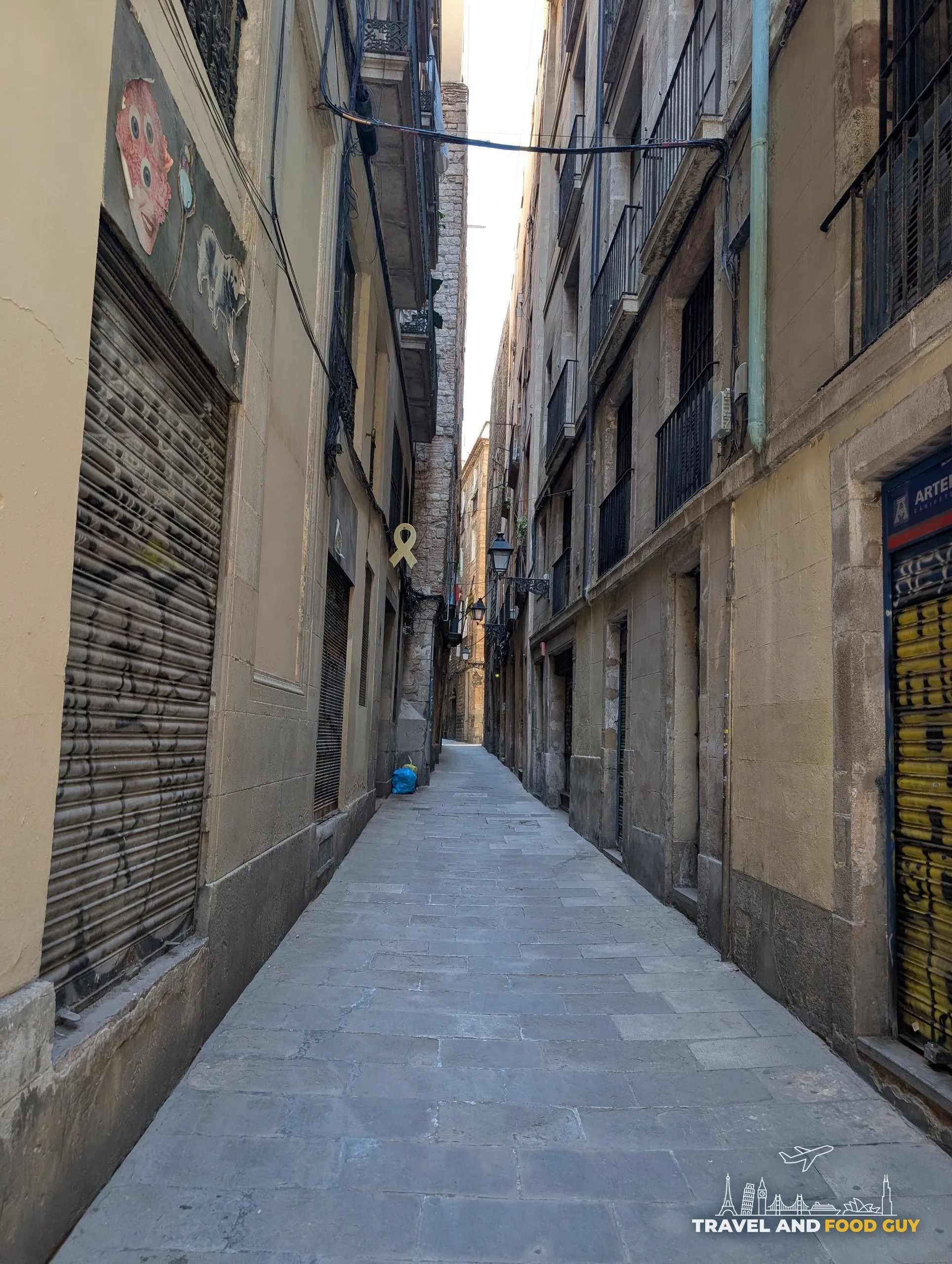
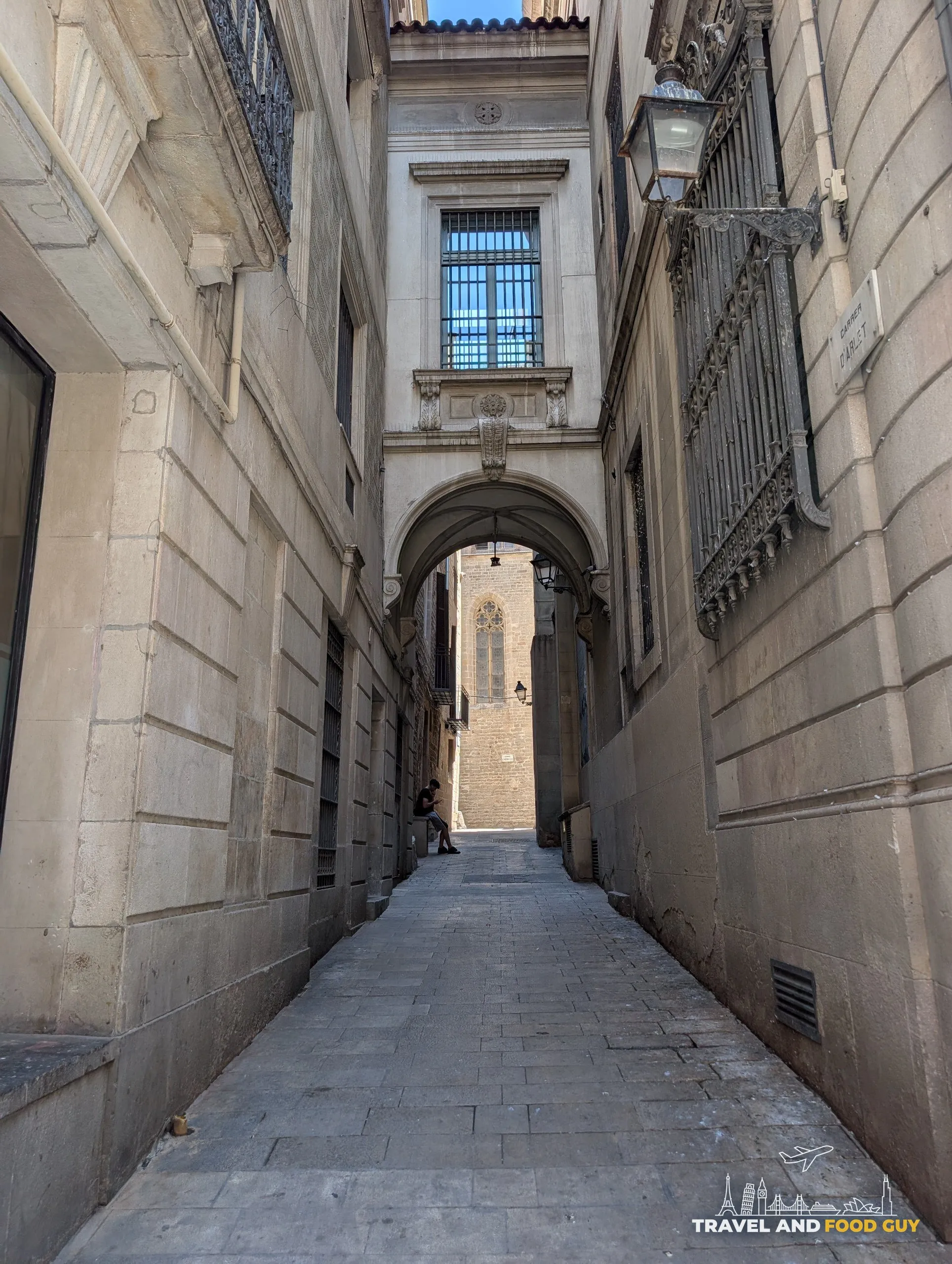
It Feels Like Rome, and Like Seville, and There Is a Reason for That
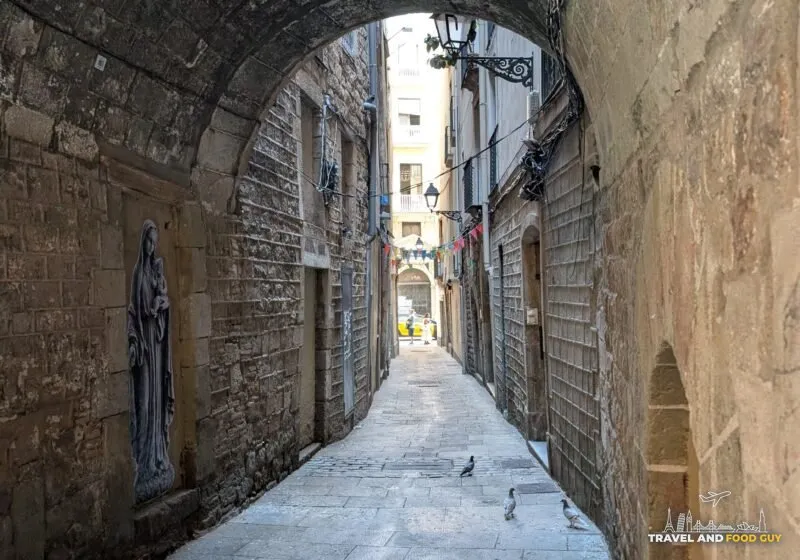
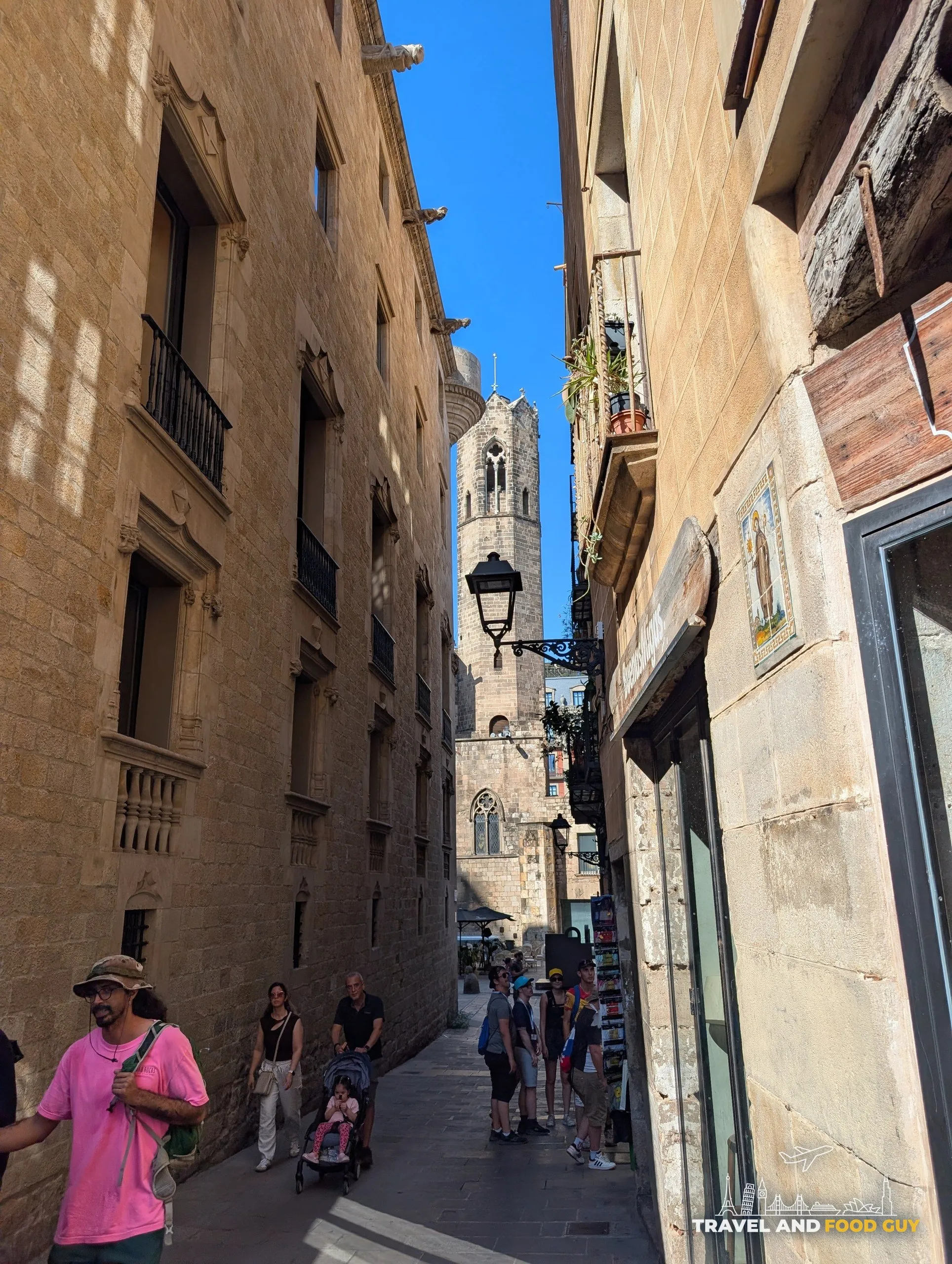
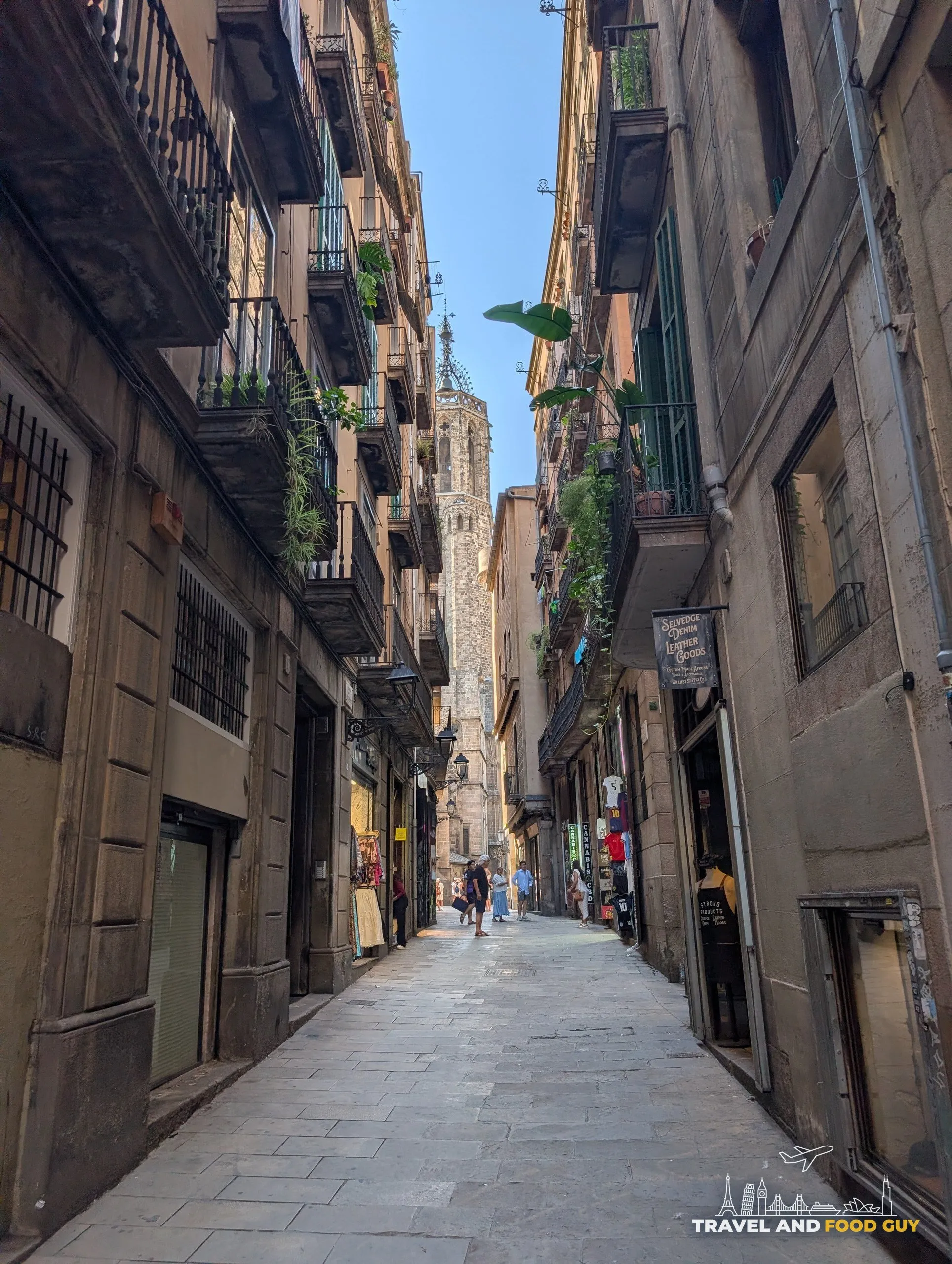
The first thing you notice is the width. Some of these lanes are barely wide enough for two people to pass each other going opposite ways. It also means the whole thing is deeply shaded in the afternoon, which in August is the difference between a walk and an ordeal.
What it reminded me of, immediately, was Rome. Step off any of the big streets in Rome and you are into little alleys and corridors that feel nothing like the avenue you just left, and this is exactly that. It also has a lot of Seville in it, which is another city where the good part is the part you can only do on foot.
The Rome comparison is not a coincidence. Barcelona started as a Roman town, and this is the piece of it that is still standing on the original street plan. You are walking a Roman city with a medieval one built on top.
What Happened Here on the Fifth of August
Everything in this section comes off the synagogue’s own information board, which we photographed and read on site. I am quoting the building rather than a travel blog, because the history of this quarter is argued over and the board is the source we can actually stand behind.
On the fifth of August in 1391 the Jewish quarter was attacked and set on fire, during a wave of rioting that had started in Seville. Around four hundred people were killed. Most of those who survived were forcibly converted. The rest fled.
The King then seized the abandoned property, and the synagogue itself was given away as a gift. Over the centuries that followed the building was used as a prison, as a grain warehouse, and as storage space. It was split in two in 1677 and 1678, which is why the vaulted ceiling and the internal partitions you are standing under are seventeenth century rather than medieval.
Excavation began in 1996. It opened to the public again in 2002. That is roughly six hundred years of the building being anything other than what it was built to be.
It Is Called the Major Synagogue and It Is Tiny
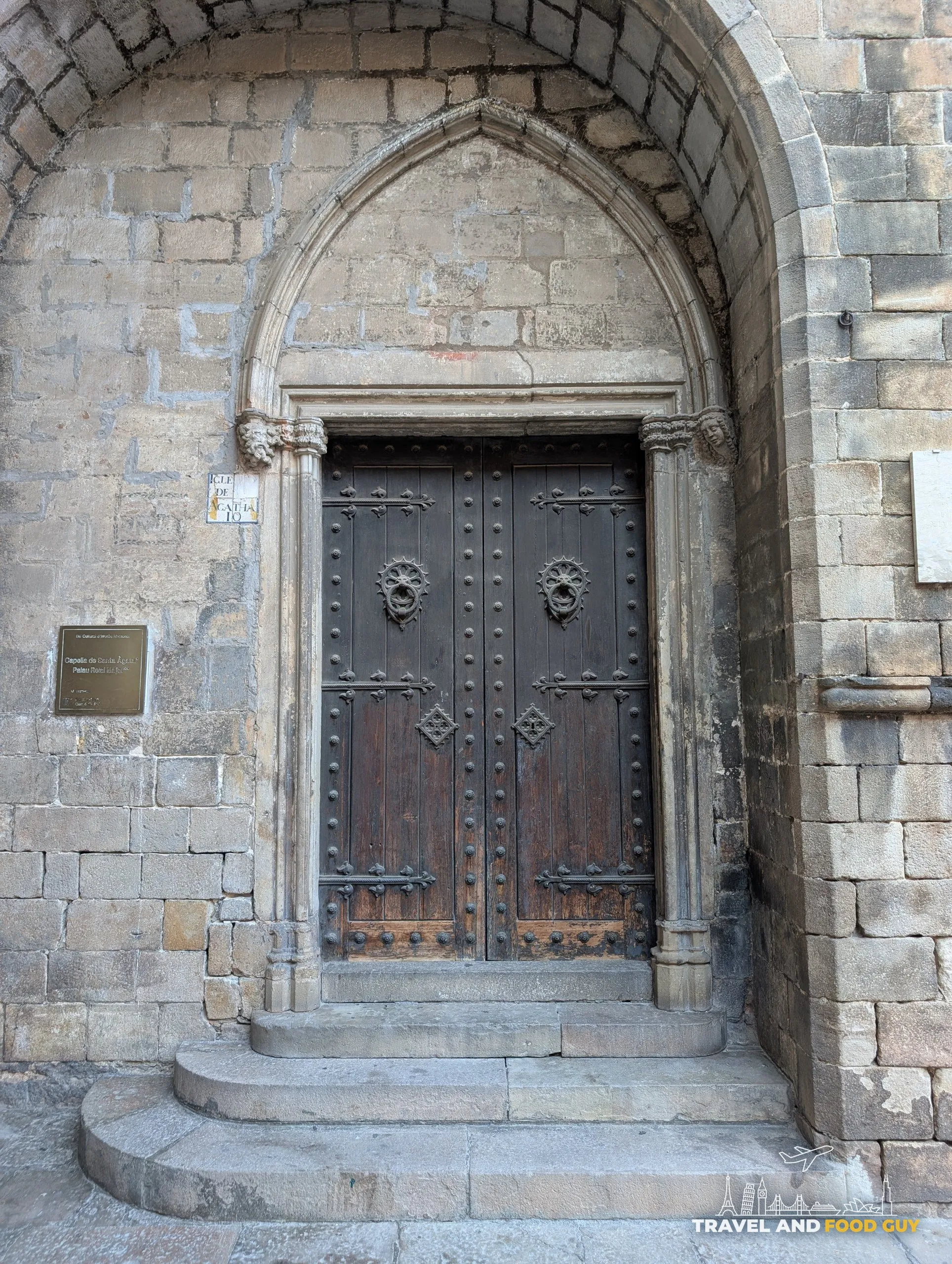
There is a small framed plaque on the stone outside, in Catalan, Spanish, English and Hebrew. L’Antiga Sinagoga. Sinagoga Romano Medieval. Major Synagogue. You would read the word Major and expect a building.
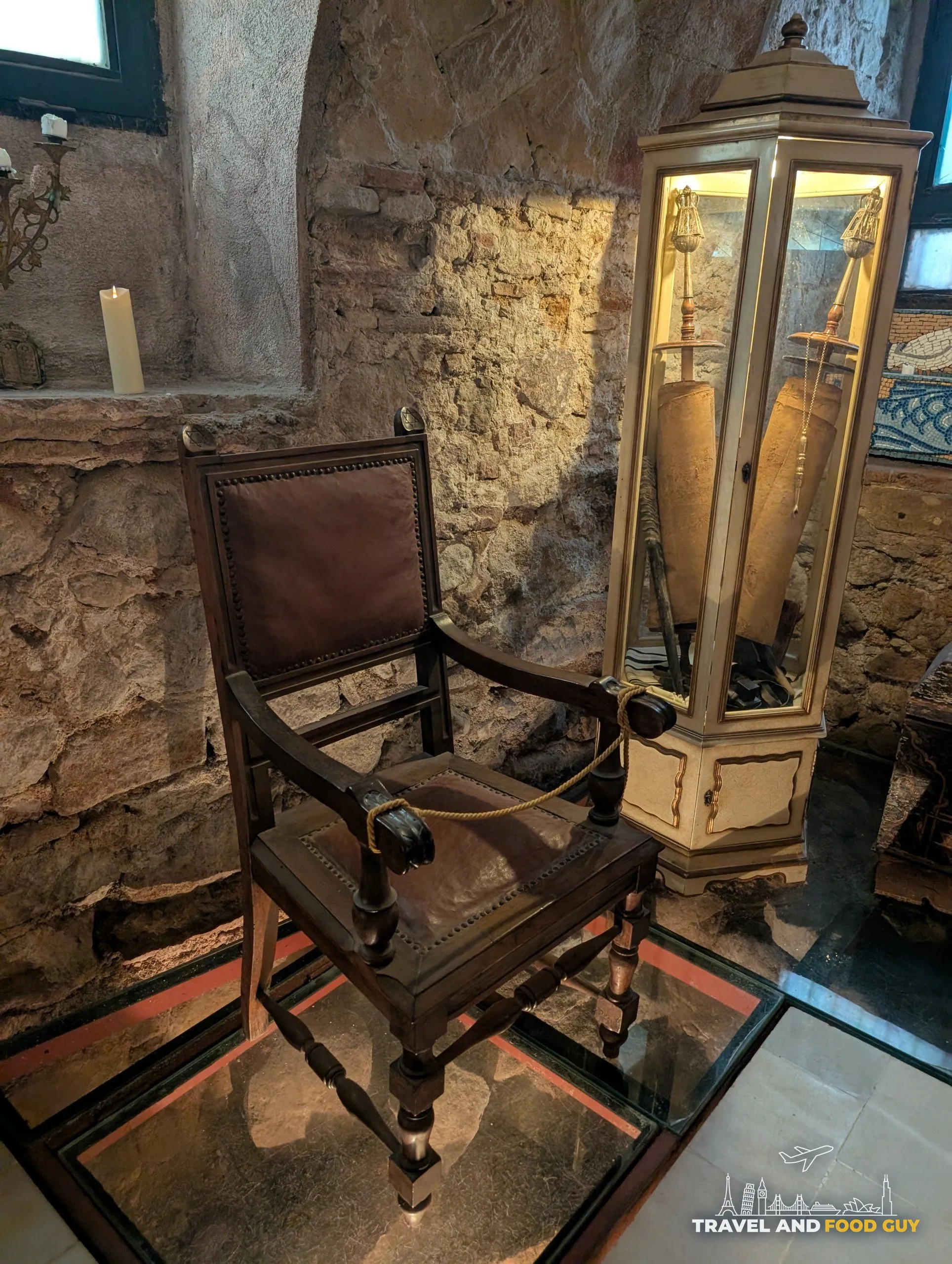
What you get is two small stone rooms, published at about sixty square meters. Standing in it I could not see it holding more than about fifty people, and that is being generous.
Major here means principal, not large. It was the main synagogue of a quarter that had several. The city’s own history museum lists a Major, a Menor, one called the Synagogue of the French, and others built privately under royal licence, plus one over in the Call Menor that converts turned into a church after 1391 and which is now Sant Jaume.
Josh and Emily spent most of the visit on the same problem, and it was not the history. It was the room. How a congregation fits in a space this size. Where everybody would have stood. Why the main synagogue of the whole quarter is smaller than a lot of living rooms. They were still asking about it when we walked out. It turns out to be the question everybody asks, and the answer you will get from most people is wrong.
Emily’s read was simpler than that. She thought the synagogue was cool, and that is where it sat for her. No bigger feeling attached to it, and I am not going to put one there. What I will say is that we walked into that quiet a few minutes after the thing in the street, and the order those two happened in is probably why the room stayed with me the way it did.
Why Is the Sinagoga Major So Small?
You will hear, and I heard, that medieval law forbade a synagogue from being bigger than the smallest church in the city, and that is why the room is the size it is. It is a great line. I went looking for the law and I could not find it.
Three things make me put it down. It circulates in versions that contradict each other, sometimes no taller than the lowest church, sometimes no bigger than the smallest, sometimes no bigger than the largest. The synagogue’s own history page never makes the claim, and says only that the room’s dimensions were the ones permitted at the time. And there is a document from 1267 in which King James authorised restoring this building and adding to its height, which is not something you need permission for if a fixed cap already exists.
What the record actually shows is a licence system rather than a ceiling. Building or enlarging needed the King’s say so, case by case. That is less exciting than the church story, but it is what the record supports, and I would rather give you that than a line you repeat at dinner and turn out to be wrong about.
Almost Everything in There Was Given to It
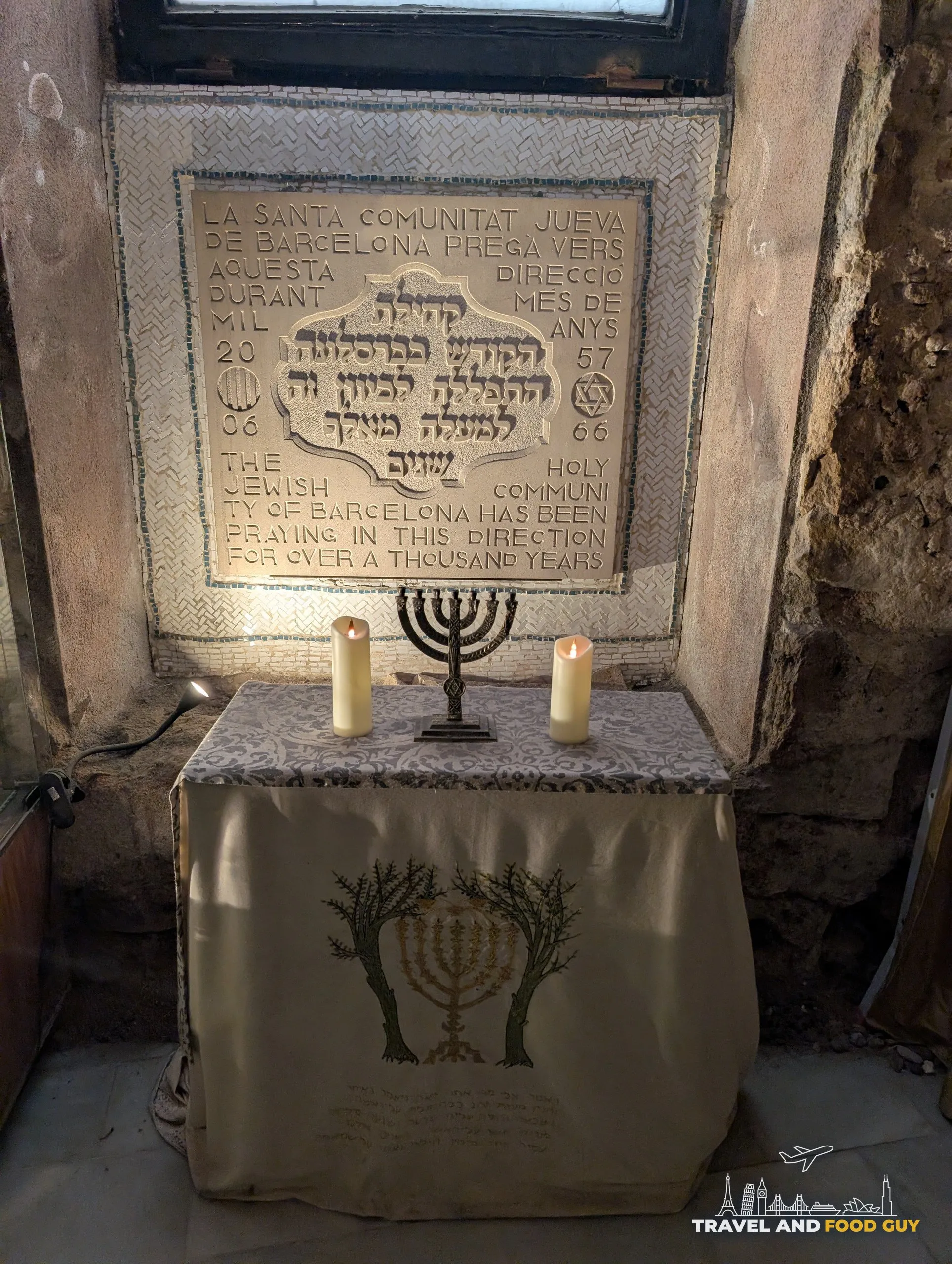
The thing that stopped me was a memorial tablet on the wall, in Hebrew and in English, above a draped table with a menorah and two lit candles on it. The English half says that the Holy Jewish Community of Barcelona has been praying in this direction for over a thousand years.
Not in this room, in this direction. That is a much bigger claim, and it is the line I would want a kid to read in here rather than the number of people killed.
Here is the part that took me a while to appreciate. The building was stripped and repurposed for six hundred years, so essentially nothing in it came down through the centuries in place. What is in there now was given to it by people, one object at a time, and most of the pieces have a story attached.
The Torah scroll is sixteenth century, donated by a New York lawyer. The wrought iron menorah is the work of a Mallorcan artist who gave it in memory of his own ancestors. The exhibition room holds a pewter collection donated by a Scottish Protestant collector named Alex Neish, which is the detail I have thought about most since. A Protestant from Scotland, making sure a Jewish room in Barcelona had something in it.
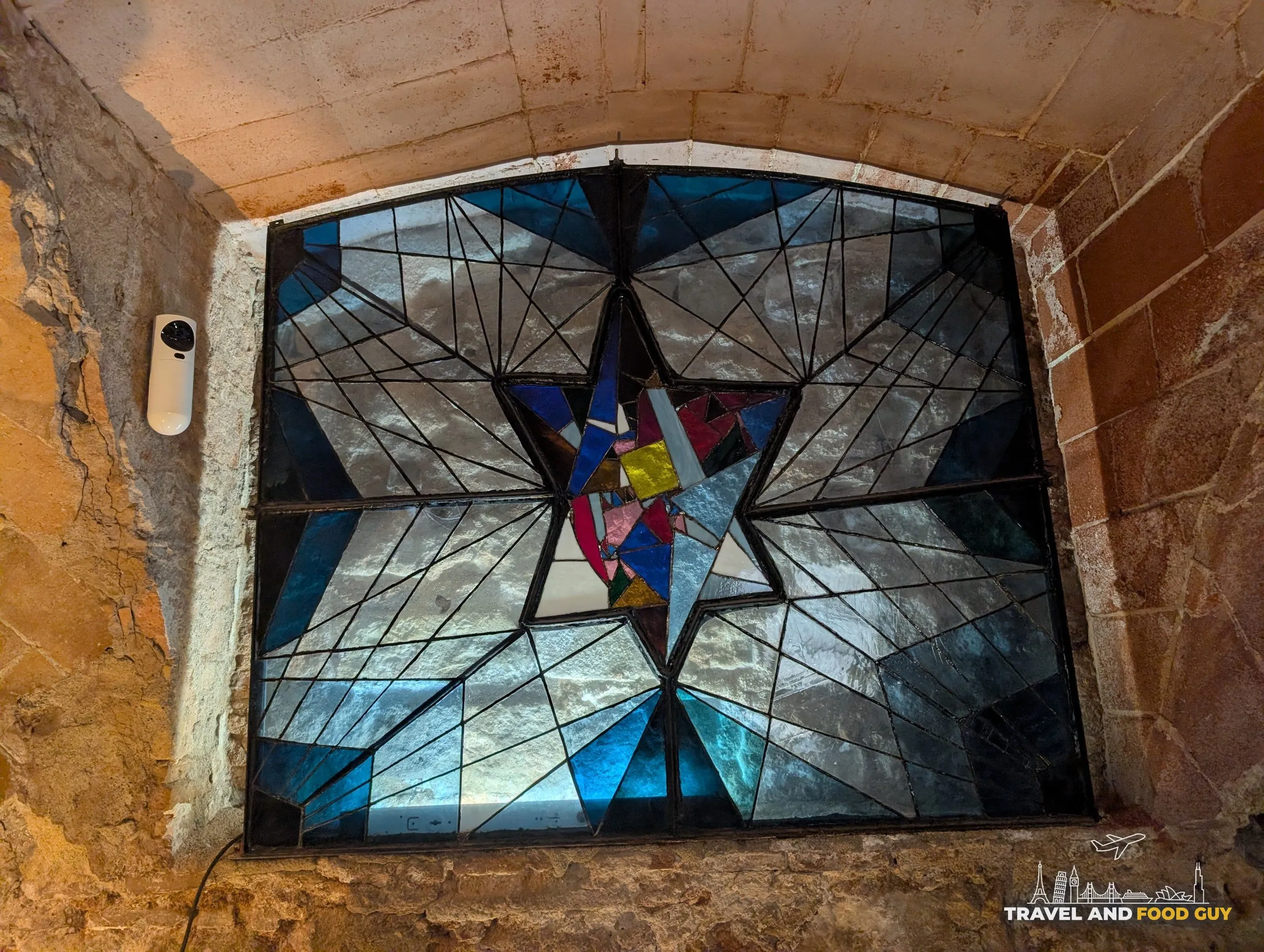
There is a stained glass Star of David set straight into the rough stone of a vault and lit from behind, and it is the image from the whole afternoon I kept going back to afterwards. One more medieval detail worth having in your head while you look at the room: seats in here were owned property. People bought them, inherited them and left them to their children, and the best places belonged to the leading families of the community.
It is dark in there, by the way. Genuinely dark, not atmospheric lighting. Worth knowing if somebody in your group is nervous about that.
Is the Sinagoga Major a Working Synagogue?
No, and I think that is worth knowing before you go so you arrive with the right expectation. There is no congregation praying here regularly. It is closed on Saturdays, which tells you most of it. What it is now is a historic site and a small museum, with a shop element by the entrance where you can pick up a keepsake, and the proceeds go back into keeping the place standing.
It does host private ceremonies, bar and bat mitzvahs and weddings, with the religious side brought in from outside. So it is a room that gets used, just not by a standing congregation.
None of that took anything away from it for us. Go for the history and the culture rather than for a service, and it delivers.
How Much Does It Cost to Visit the Sinagoga Major?
Five euros a person. That is what it cost the four of us and it matches the flat price the synagogue publishes on its own site, which also includes a paper map of the quarter. No reduced child rate is published anywhere, so if you are travelling with kids do not budget for one.
Hours are the part to check on the morning you go, because the site contradicts itself. Its ticket page shows a timetable with a break in the middle of the day, while its home page publishes a summer schedule running straight through from ten in the morning to six in the evening. Both agree it is closed on Saturdays. Booking online lets you pick a date and a time slot, and I would do that rather than turn up on spec, because when we looked, a third party listing was showing no availability at all.
For five euros a head I would call it good value for what it is. Ten or fifteen minutes inside, and you come out knowing something about the city that most people walking past the cathedral do not.
Is the Sinagoga Major Really One of the Oldest Synagogues in Europe?
You will see that claim everywhere, and the honest answer is that it is contested, so I am going to lay out both sides rather than repeat it.
The synagogue’s own site describes it as one of the oldest in Europe and one of the last to be rediscovered. That position rests on documentary work by the Catalan historian and archivist Jaume Riera i Sans, who reconstructed where the medieval synagogue stood from a tax collector’s ledger, and on the excavation of Roman era foundations beneath the building on Carrer de Marlet.
Against that, Catalan specialists have argued the identification is not settled. The heritage archaeologist Eduard Riu-Barrera published a piece in the history journal L’Avenc under the blunt title of the false synagogue of Barcelona. Victoria Mora, when she directed the city’s own Call interpretation center, argued that the medieval synagogue stood somewhere inside this block but that its entrance would have been on the neighboring street rather than on Marlet. The excavation turned up Roman and medieval walls, but no Jewish artefacts.
Both sides accept that Roman era remains sit under the building, and that the principal synagogue of the medieval Call stood somewhere inside this block. Where they part company is whether this exact room is it. Honestly, I found the argument more interesting than the claim, so I would rather give you both sides than a slogan.
The Roman Wall Nobody Charges You For
This one is free, and it is the stop I would least want you to walk past.
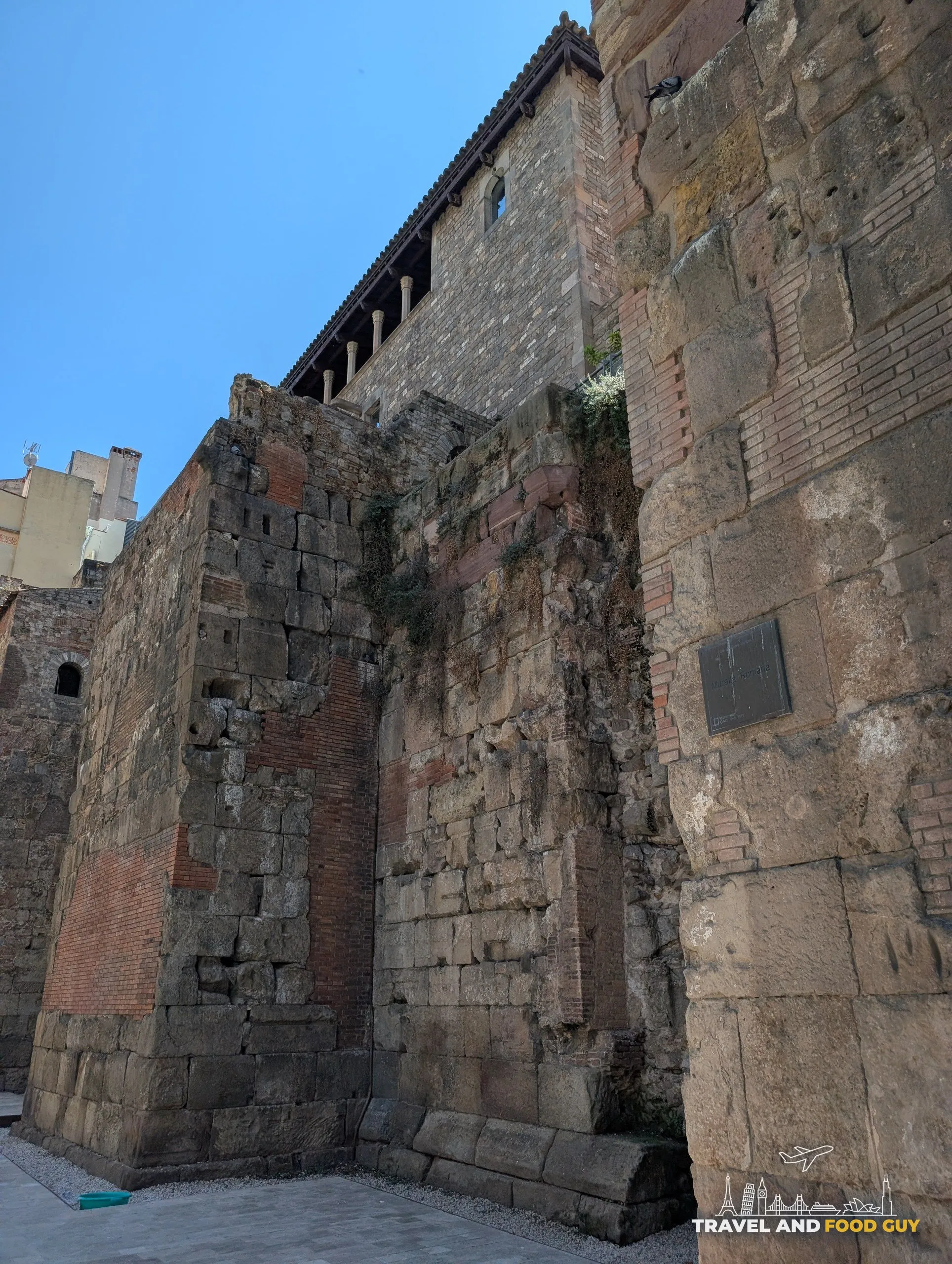
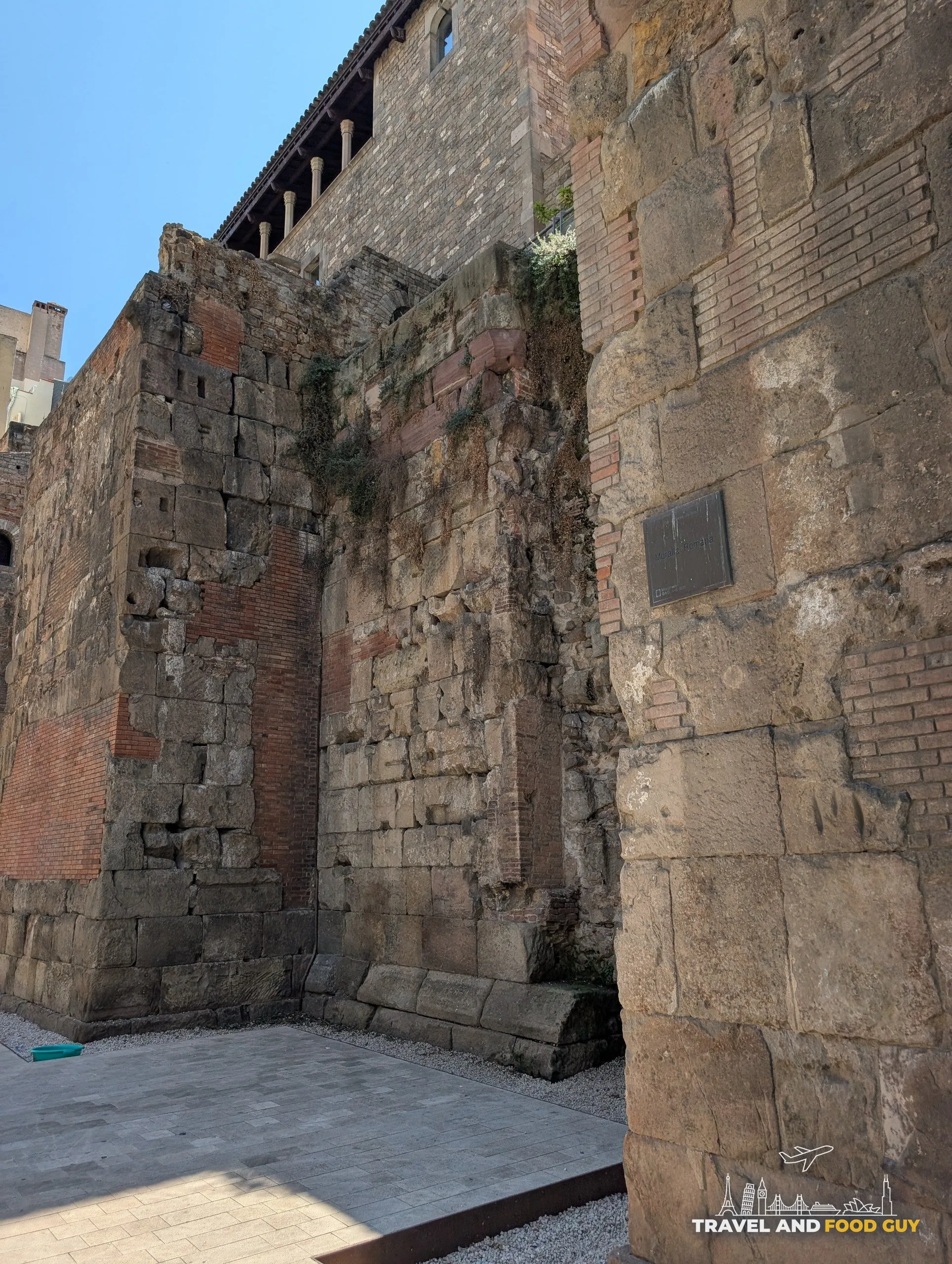
You turn a corner and there is a wall of Roman stone running up well above head height, with the medieval city built directly on top of it and a gallery along the top. The only interpretation is a small dark plaque that reads Muralla Romana. No fence, no ticket desk, nothing between you and it. A green bucket was sitting on the gravel at the bottom of it.
The marker dates this stretch to the third and fourth centuries and names the technique it was built with. Late Roman masonry, holding up a medieval building, on an open street corner with nothing to stop you touching it. That is something about Barcelona you do not really get until you are standing in front of it.
If you are doing this with children and the synagogue feels like a lot, this is the stop that does the same work for free and in daylight.
The Route We Actually Walked
Nobody else seems to publish an order for this one, so here is the order that makes sense of it, rather than a claim about exactly where our feet went. On the clock we were in El Call itself from about a quarter to four to just before five, then out into the wider Gothic Quarter on foot from around quarter past five until about ten to six.
- Into the lanes off Carrer del Call. This is the narrow section, and it is the part that feels old before anybody tells you anything.
- Sinagoga Major on Carrer de Marlet. It is one room and an exhibition room, so budget accordingly.
- Placa Sant Jaume, which is where the quarter opens out.
- North toward the cathedral, under the Pont del Bisbe on Carrer del Bisbe.
- The Roman wall, up at the cathedral end of the quarter. Free, outdoors, and a good reset after a dark room.
- Around the back of the cathedral to the apse, with Carrer de la Llibreteria and gelato somewhere in the middle of all this rather than saved for the end.
Call it two hours at a family pace with a stop inside the synagogue and a gelato somewhere in it. You could move through it much faster if you were only walking, and you would get less out of it.
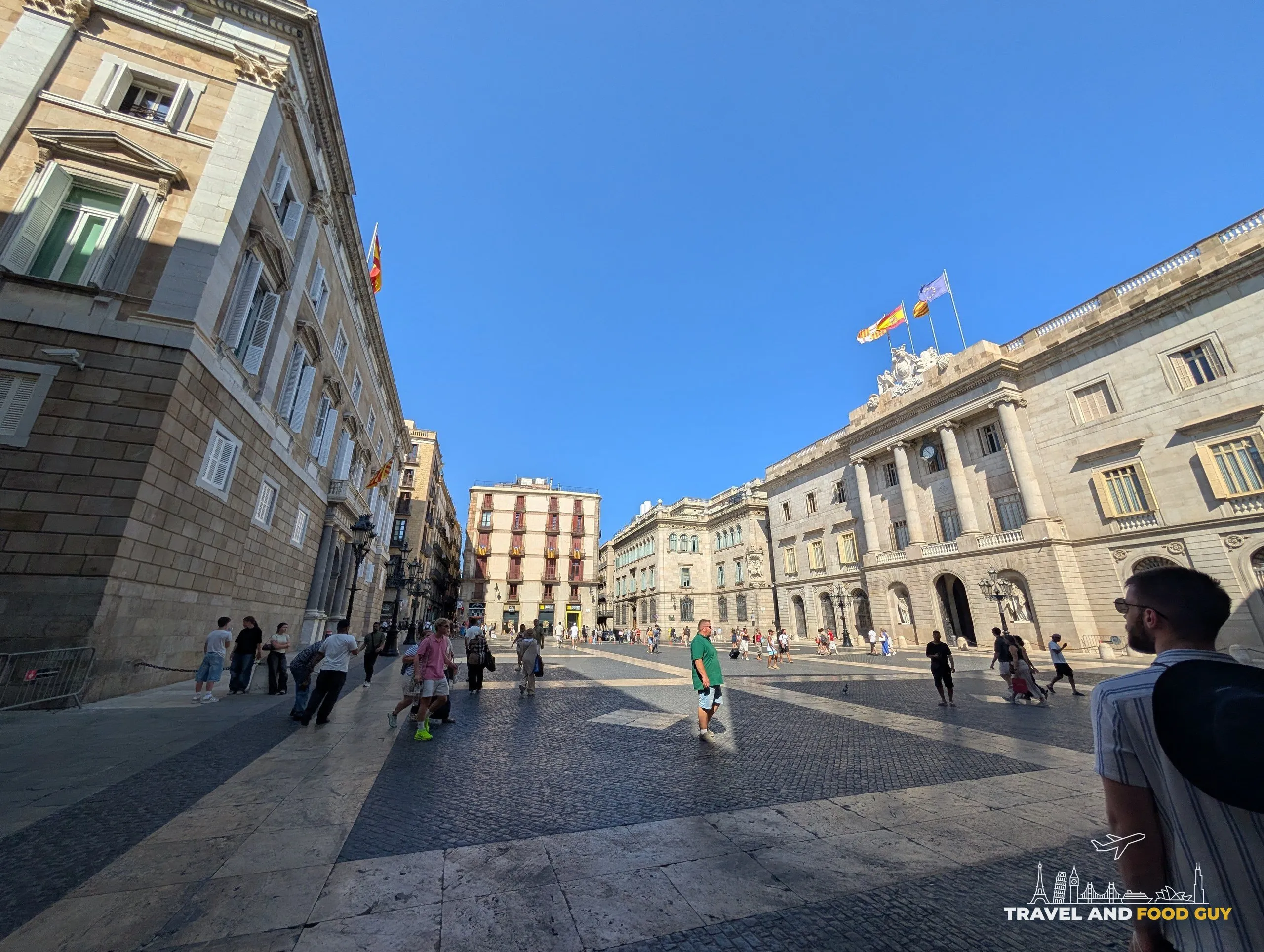
Placa Sant Jaume is where you come up for air. Wide open, full of sun, with the Generalitat on one side and the city hall on the other, and the two of them staring at each other across it.
Round the back of that city hall block is Placa Sant Miquel, where we had eaten lunch a couple of hours earlier. If you want the bill for that, it is in our Tapas San Miguel review, and it is barely off this route, because the city hall block runs straight between the two squares.
The Pont del Bisbe Is Not as Old as It Looks, and Look Up Anyway
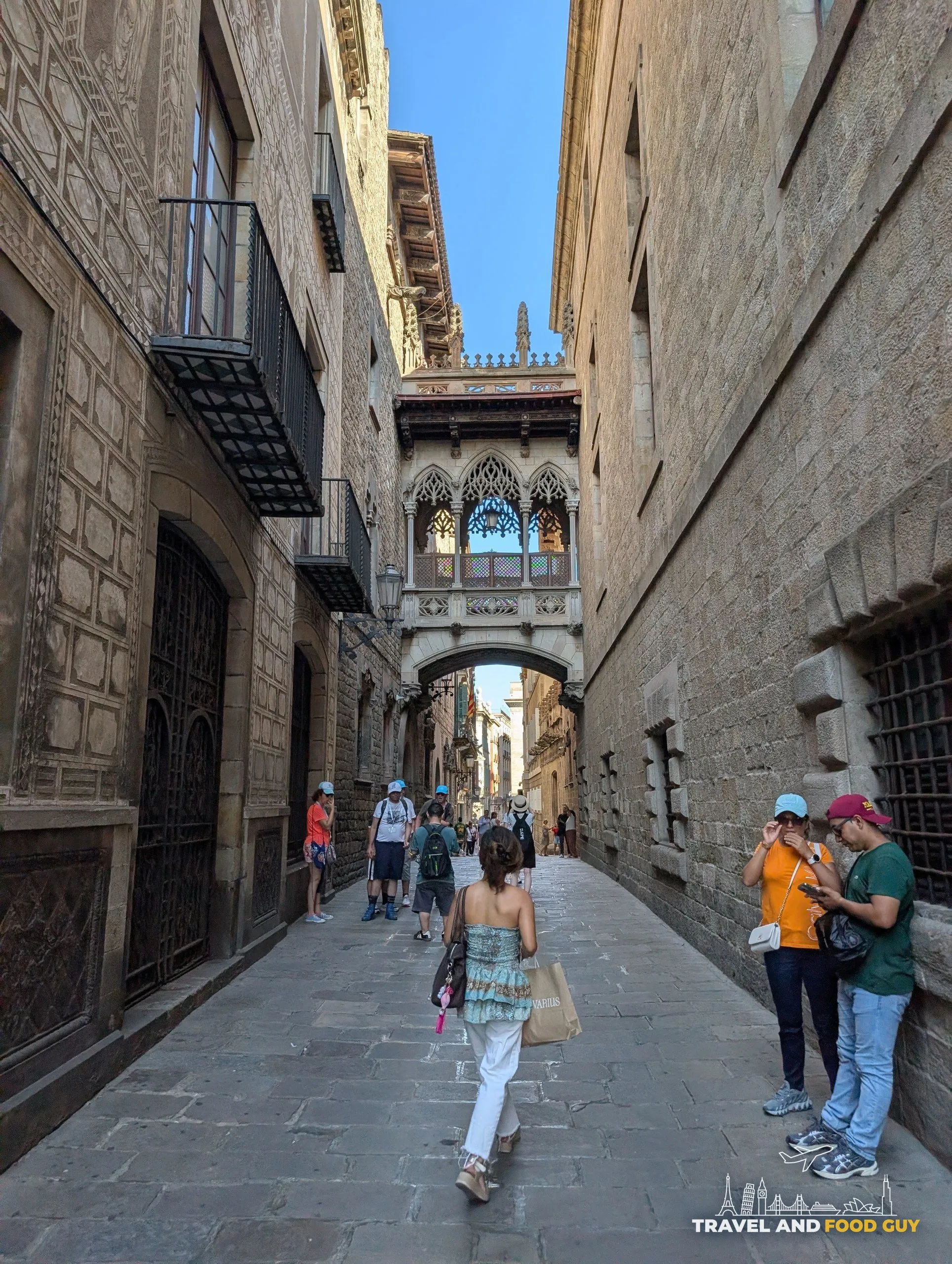
The carved stone bridge over Carrer del Bisbe is one of the most photographed things in the Gothic Quarter and it is a twentieth century addition, built for the international exposition Barcelona hosted at the end of the nineteen twenties, to a design by the architect Joan Rubio i Bellver.
I am not knocking it. It is a beautiful piece of work and it does exactly what it was built to do, which is make a street look like the middle ages. But there is a difference between old and medieval, and knowing which one you are looking at is half the fun of the quarter.
Walk underneath and look straight up. There is a skull with a dagger driven through it carved into the underside. Local legend says that if the dagger is ever pulled out, the city falls. Another version says walk backwards under the bridge looking at the skull and make a wish. A detail like that grabs a kid faster than anything I could tell them about Roman masonry, and I am telling you because ours missed it completely. Josh and Emily walked under that bridge with no idea any of it was up there. So say it before you get to the bridge, not after.
Go Round the Back of the Cathedral
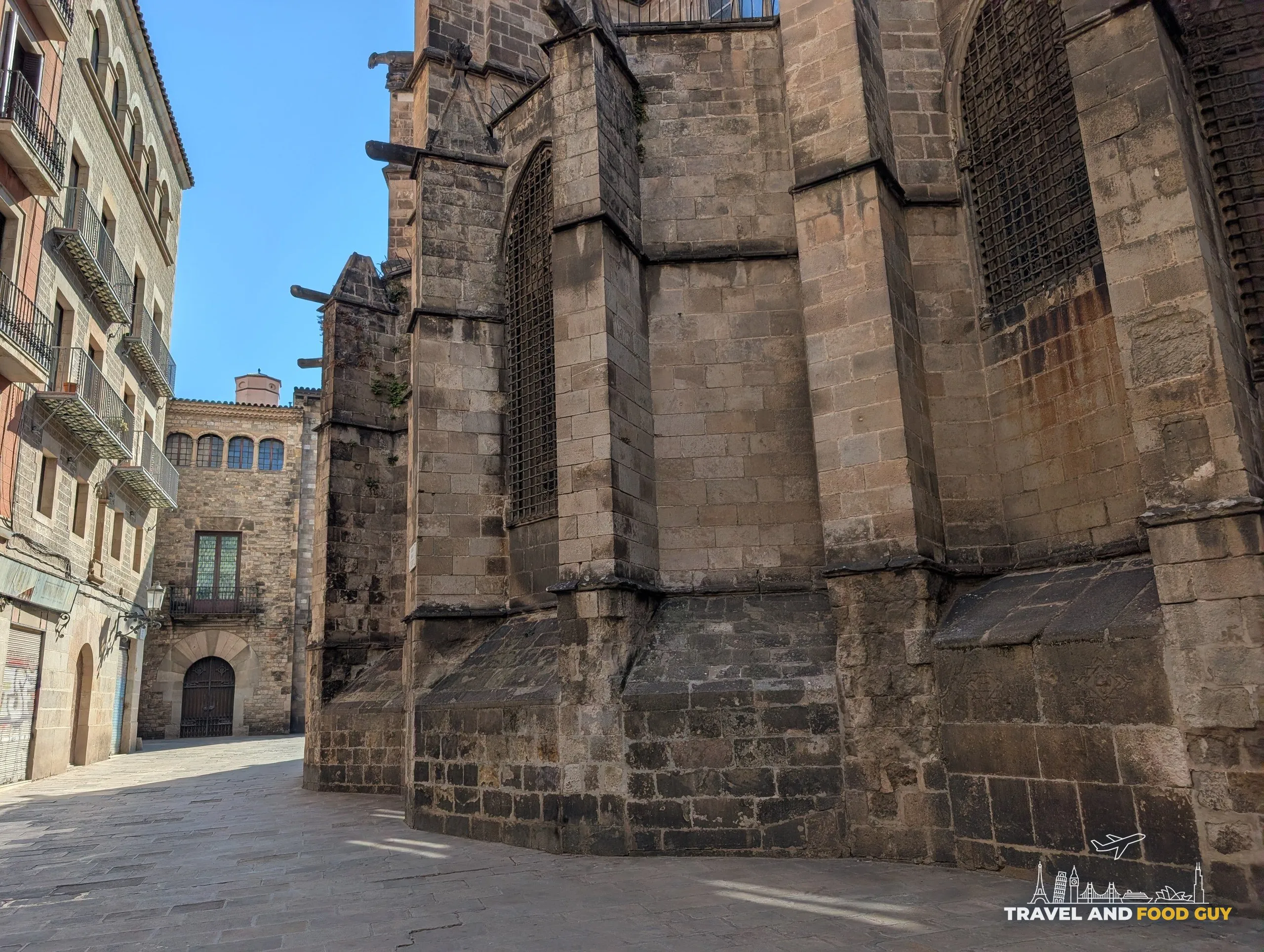
We did not go inside the cathedral, and I am not going to pretend to review a building we looked at from the street. From the outside it is spectacular, and the part I would send you to is the part almost nobody bothers with.
The front from the big open square is the shot everybody takes. The apse round the back gets far less attention, and it is where the stone comes down into a small square and you can actually see the shape of the building rather than the facade.
The Double Bass at the Cathedral Door
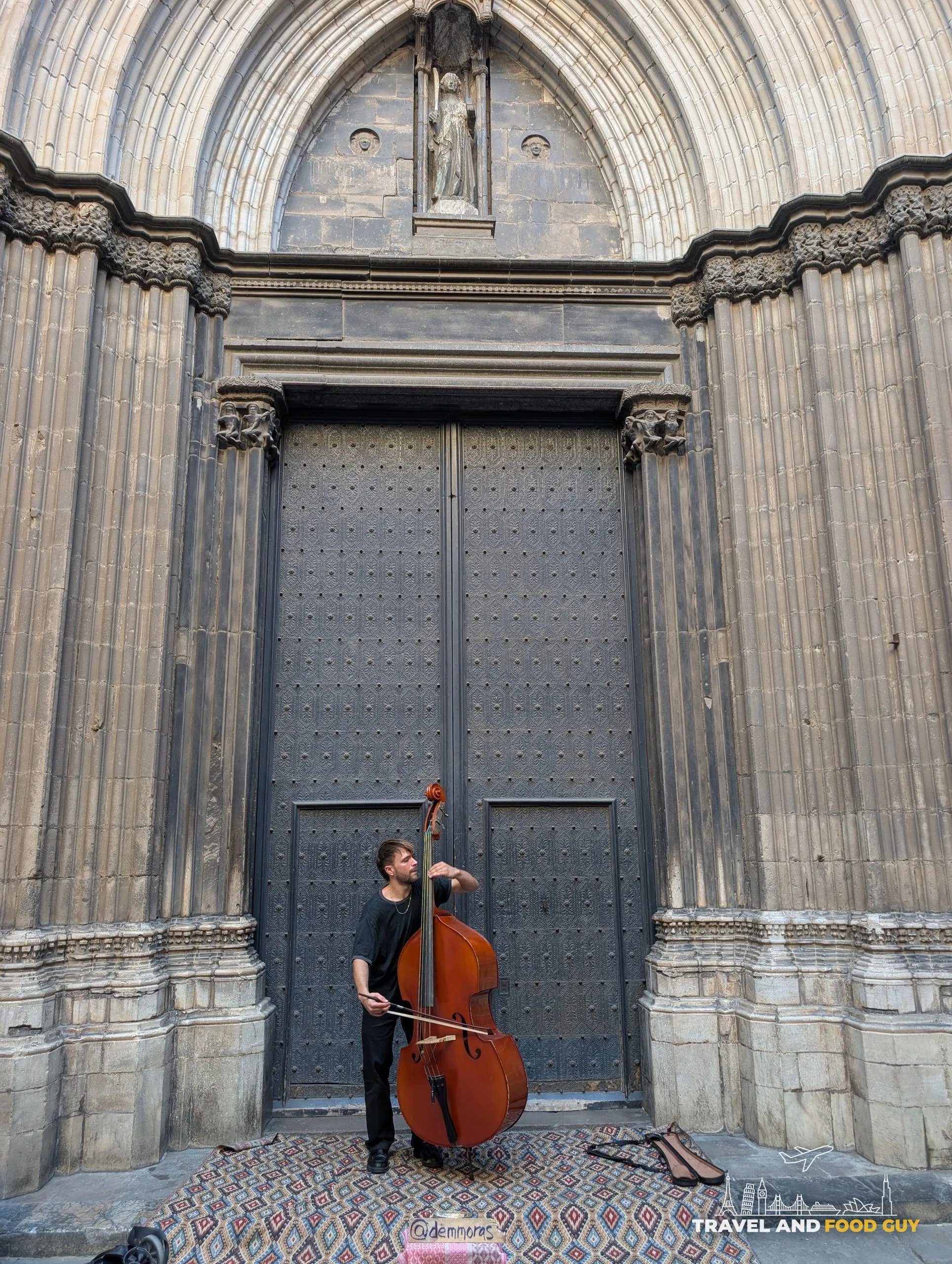
There was a man playing a double bass at one of the cathedral doors. Rug down, case open, standing in the middle of an arch four times his height.
Josh and Emily have a running question about buskers, which is whether the person is actually playing or whether it is a recording and they are miming over it for tips. They ask it every time. This one Josh settled himself. From where we were standing he could see the man’s hands and read his technique, and he said so out loud. This guy was absolutely playing, and it sounded beautiful.
It meant more to us because Josh plays the double bass himself. You see buskers with a guitar. You see them with a violin. I do not think any of us had ever seen somebody haul an instrument that size out into a street and play it well, and for a kid who practises one at home, watching a stranger do that in front of a cathedral is not a small thing.
He had a hand painted sign propped on the rug that read @demmoras, which is the polite way of saying find me later. So if you were the reason four Americans stood still in the heat for a while, that is you, and thank you.
Is the Gothic Quarter in Barcelona Safe?
Here is the thing that actually happened to us, and it is the reason I am not going to give you a breezy answer.
We had just come from lunch and we were walking up the little street toward the Sinagoga Major when police vehicles pulled in and several officers got out and started running, looking for somebody. We did not know what was happening. We ducked into a storefront and waited it out.
Vika, Josh and Emily were all shaken up by it, and their first instinct was to get out of that alley completely. They started walking away from it. I was calmer, and my reasoning is that once something has happened somewhere, the last place the person is going to be is the spot it happened in, especially with that many police standing in it. That makes it close to the safest patch of street in the quarter. It is also not an argument anybody wants to hear in the moment. It took the three of them a while to come down, and for a stretch there they did not want to see the sites in this quarter at all. They just wanted to be somewhere else. Once everyone had settled we carried on and walked the rest of it, and everyone was fine with that.
The kids took it hardest. Both of them said straight out that they felt unsafe and wanted to know whether we should still be walking around. What I told them is the honest answer. In a quarter like this one that is unfortunately normal, and it is exactly why we travel the way we do, with the bags and the purse and the pockets all arranged the way they are before we leave the room in the morning. Those habits are not paranoia. They are the reason the person the police were chasing had nothing of ours.
It put all four of us on alert for the rest of the day. We did not let it take the afternoon.
What we found out afterwards was that somebody walking through had their purse snatched and the thief had run. That is what the officers were chasing.
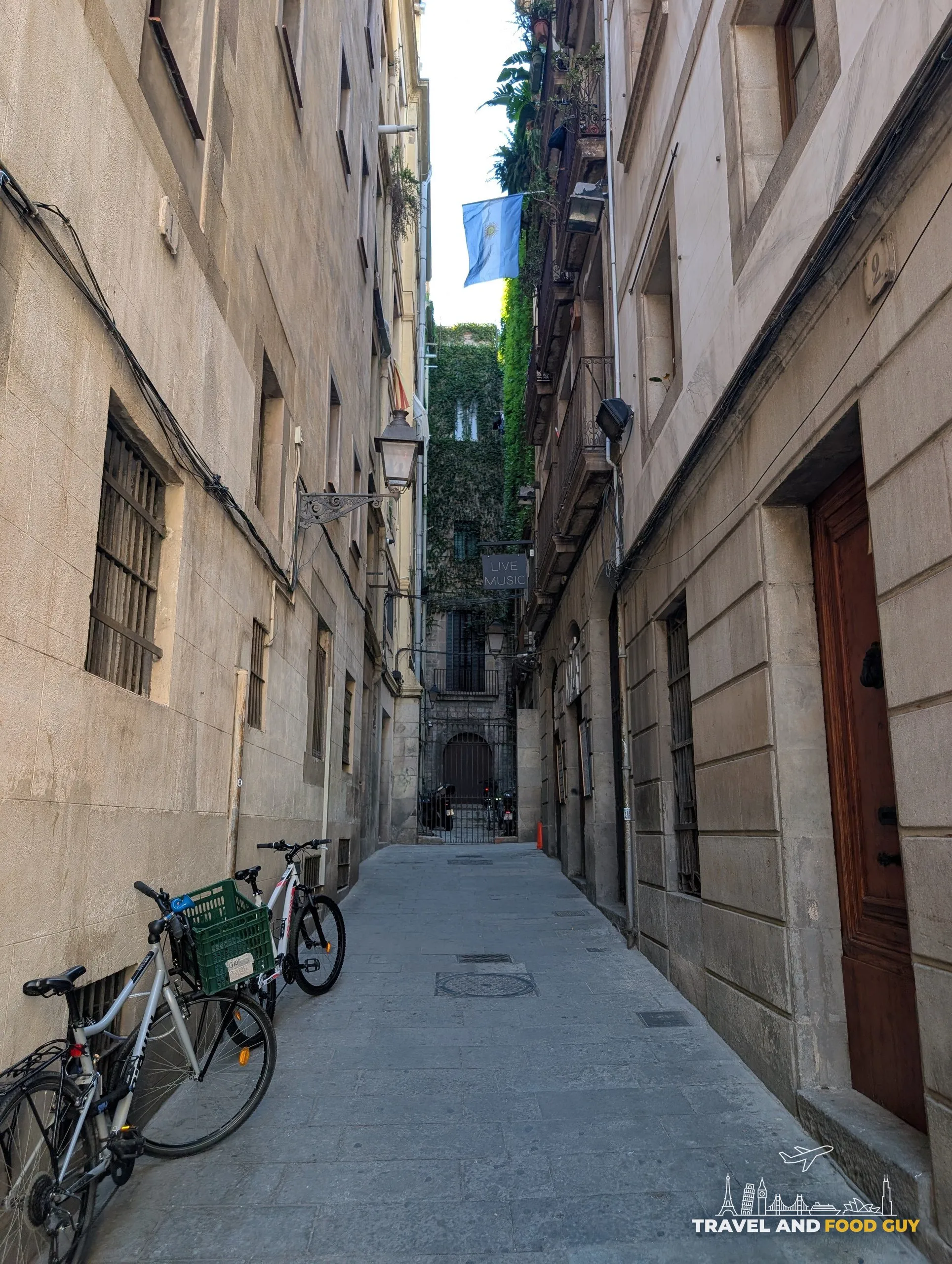
So, is it safe? We walked it as a family of four into the early evening and nothing happened to us, and nothing about the quarter felt like a place to be wary of. It is busy, it is well used, and people live in these lanes, which you can tell from the bikes parked along them.
But the pickpocketing warning you read about Barcelona is not a formality, and we watched the consequences of it play out ten meters from where we were standing. It is not danger. It is theft, and it is worth planning around.
How We Carry Money and Cards in Europe
None of this is clever. It is just what we actually do, and after that afternoon I am glad we do it.
- Bags in front, not on the shoulder. Vika wears her purse across the front of her rather than hanging at her side. I carry what the family calls my man bag, a one strap backpack, round the front as well. It looks awkward. It is also the single easiest thing you can do.
- Two cards on two different accounts, one on each of us. This is the one people skip. If we both carried cards on the same account and one got taken, closing that account would kill both cards at once. Different accounts, split between two people, means a theft is an inconvenience rather than the end of the trip.
- Tap to pay from the watch or the phone. The card mostly stays put. Nothing comes out of a pocket in a crowd.
- No flashy jewelry, and no big handfuls of cash. Most of the cash stays in the safe at the apartment and we carry what we need for the day, tips and a gelato. My camera is out because I am filming, but it is on a wrist strap.
You can do all of it and still get unlucky. We were fine and somebody else on the same street was not, and I do not think that is because we were smarter than them. It just tilts the odds, and tilting the odds is the whole game.
Where to Stop for Gelato in the Gothic Quarter
Gelaaati DI MARCO, Carrer de la Llibreteria 7, a short walk from the cathedral. I want to be honest about how we found it, because it was not luck. I sat down and researched the highest rated gelaterias in the Gothic Quarter that make their own gelato in house, then ran the same search a second way to see if it agreed with itself. Both roads led here.
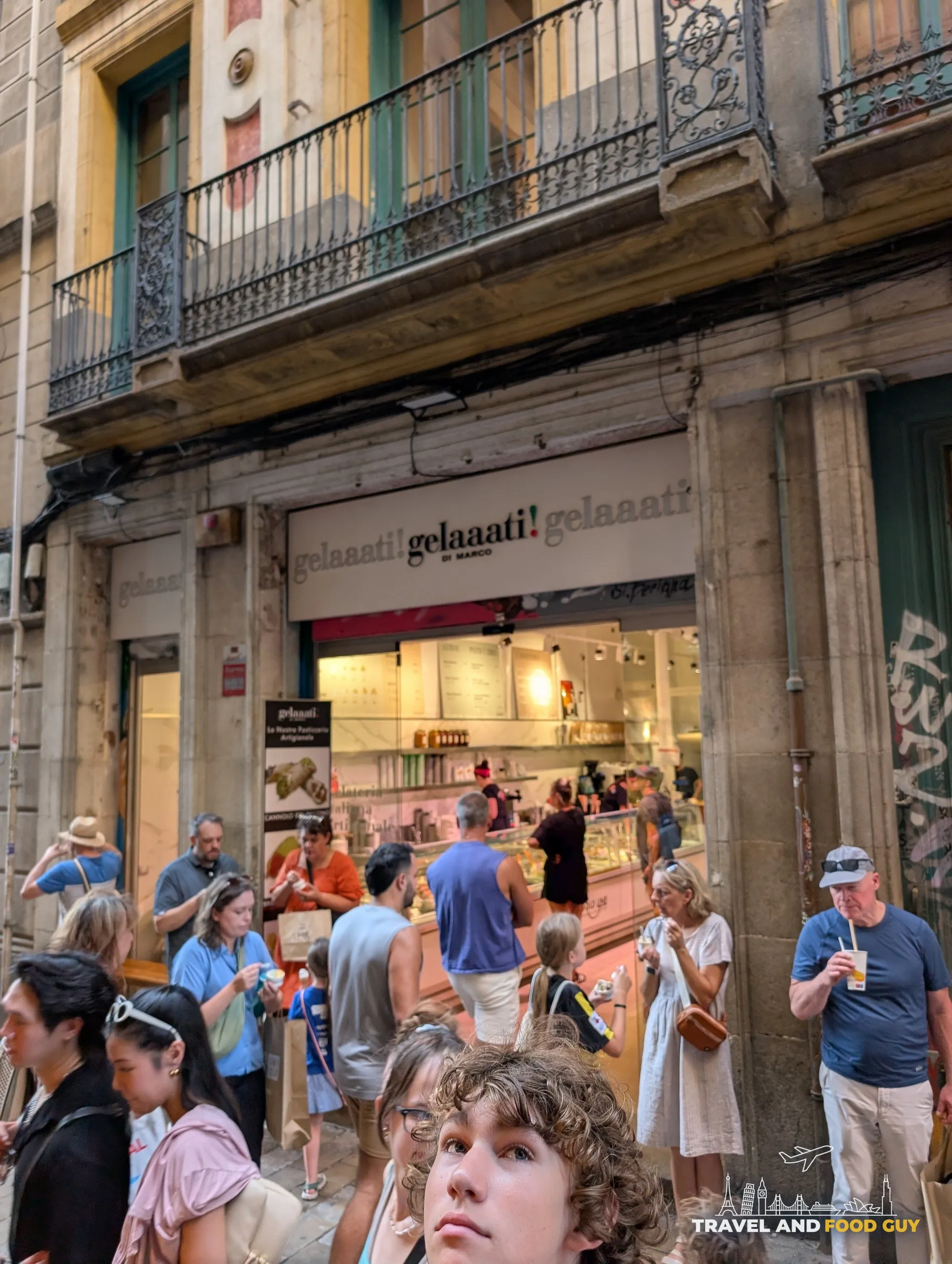
There was a line to get in and a crowd of people out on the narrow street eating, which on a lane this width you cannot miss.
It holds a 4.7 on Google across more than five thousand reviews. Its actual credentials are better than that: a place in Dissapore’s fifty best gelaterias in the world, an Eccellenze Italiane certificate, and a spot on Jordi Roca’s own list of the best ice cream shops on the planet. When the pastry chef from El Celler de Can Roca picks your gelateria, that is not a TripAdvisor sticker.
I asked for whatever they are known for and got pointed at their GOLD LINE, which is the eight flavour range their maestro picks out as the top of the shop. That is the thing to ask for at the counter.
What I walked out with was a brown scoop shot through with actual chunks, sitting on a peach one, and it was the best gelato of the entire trip. I stood on that street genuinely surprised by how good it was. All four of us loved it, and it is probably some of the best gelato we have had anywhere, not only in this city. The tell was Vika. She does not like sweets, and she loved mine. Their GOLD LINE peach is made with DOP Ordal peaches and cava, and they only sell it in July and August, so if you are there in summer that is the one to ask about.
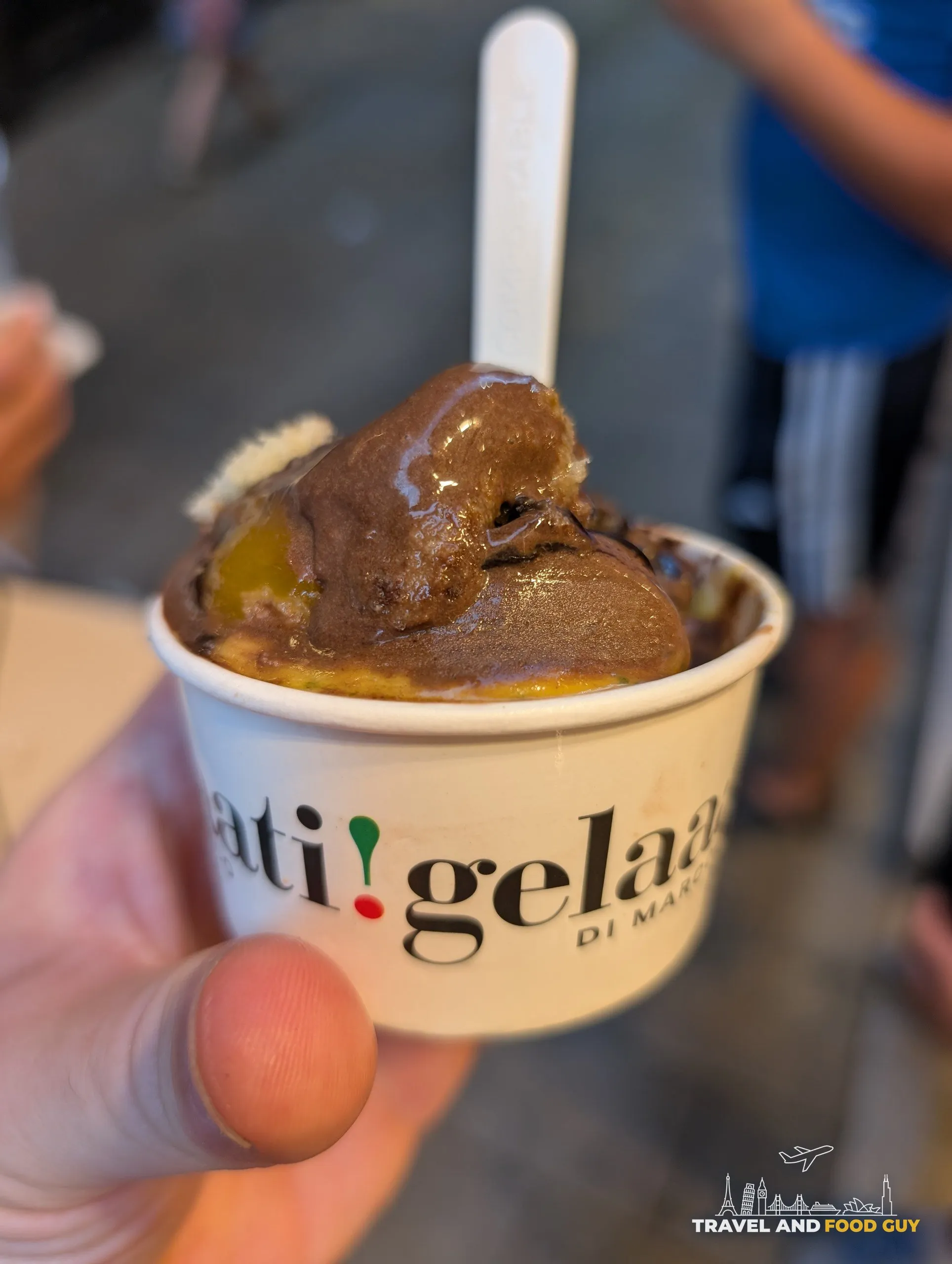
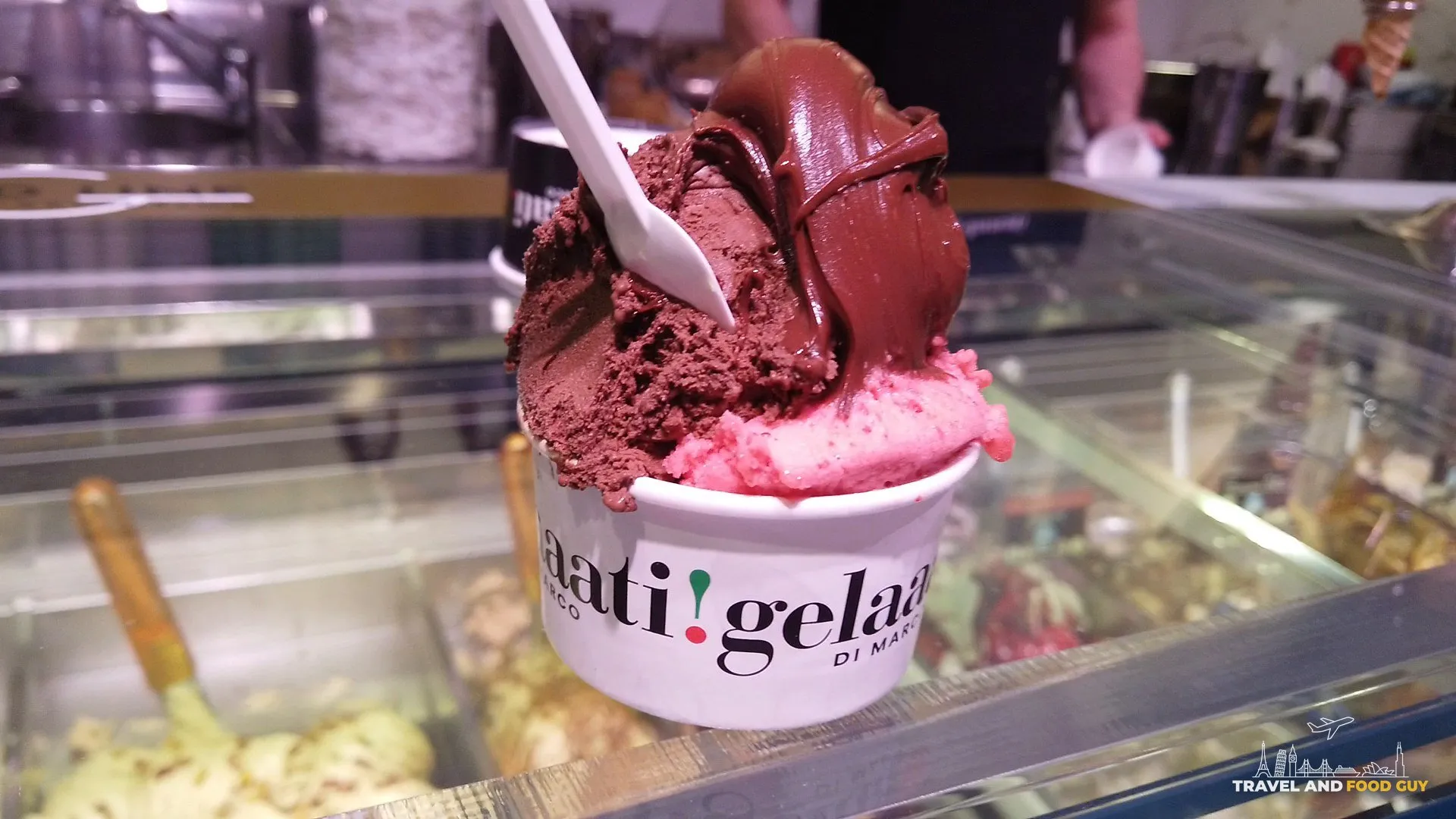
This is Josh’s, caught the second it came up off the case. Chocolate on top with a thick ribbon of chocolate sauce laid over it, sitting on a raspberry scoop the color of a highlighter pen.
Look past the cup and you can see the case behind it, the pistachio tub with a spatula standing in it. That one photo pretty much sums up this place. It is made on the premises and it looks like it.
All four of us ended up trying each other’s, which is the correct way to do a gelato stop and the reason we never order four of the same thing. The verdict was unanimous and it was not close. Both cups were outstanding. What everybody kept coming back to was that it tasted real, not store bought, which is an easy thing to say and a very hard thing to actually pull off.
One practical note. Their case only holds about half of their published flavour list at any one time, so what they hand you may not be on the website when you get home. Take a photo of the label if you want to find it again.
On price, around 5,20 for a small with two scoops and about 5,80 for a medium, and some flavours carry a small supplement. That is a couple of euros more than the other gelaterias we went to on this trip, and it was worth every cent of the difference. For contrast, the most expensive was in Florence, at a place that is supposed to be one of the best in the city, where three cups came to close to thirty euros. Three cups usually runs us twelve to fifteen. That one was tasty and it was not worth the money. This one was.
How Long Does It Take to Walk El Call?
El Call on its own is about an hour with a stop inside the synagogue. We were in it for a little over an hour. Add the wider Gothic Quarter loop past the bridge and the cathedral and you are at around two hours in total, which is what it took us at the pace of a family who had already done a four hour tour and a long lunch that day.
The quarter is small. The reason it takes two hours is that you keep stopping, not that you keep walking.
Is El Call Worth Visiting With Kids?
Yes, with two honest caveats.
The first is that the history here is heavy, and you should decide in advance how much of it you want to hand over. The number on that board is around four hundred people killed. That needs a real conversation, and it is easier to have it walking out into a sunlit square afterwards than standing in a dark room.
One more thing to know before you wander. Placa de Sant Felip Neri is a small square inside this quarter and it is not a neutral one. It was bombed during the Spanish Civil War and around forty people were killed, many of them children sheltering there. The shrapnel scarring is still on the church wall and there is a memorial. It is beautiful and quiet and you can walk into it without warning, so decide in advance whether you want to explain it.
The second is that a single small room is not, on its own, going to hold a younger child. What makes it work is the sequence. Narrow lanes, then the small dark room, then a Roman wall you can stand under for nothing, then a bridge with a skull on it, then a man playing a double bass at a cathedral door, then gelato. Every one of those is short.
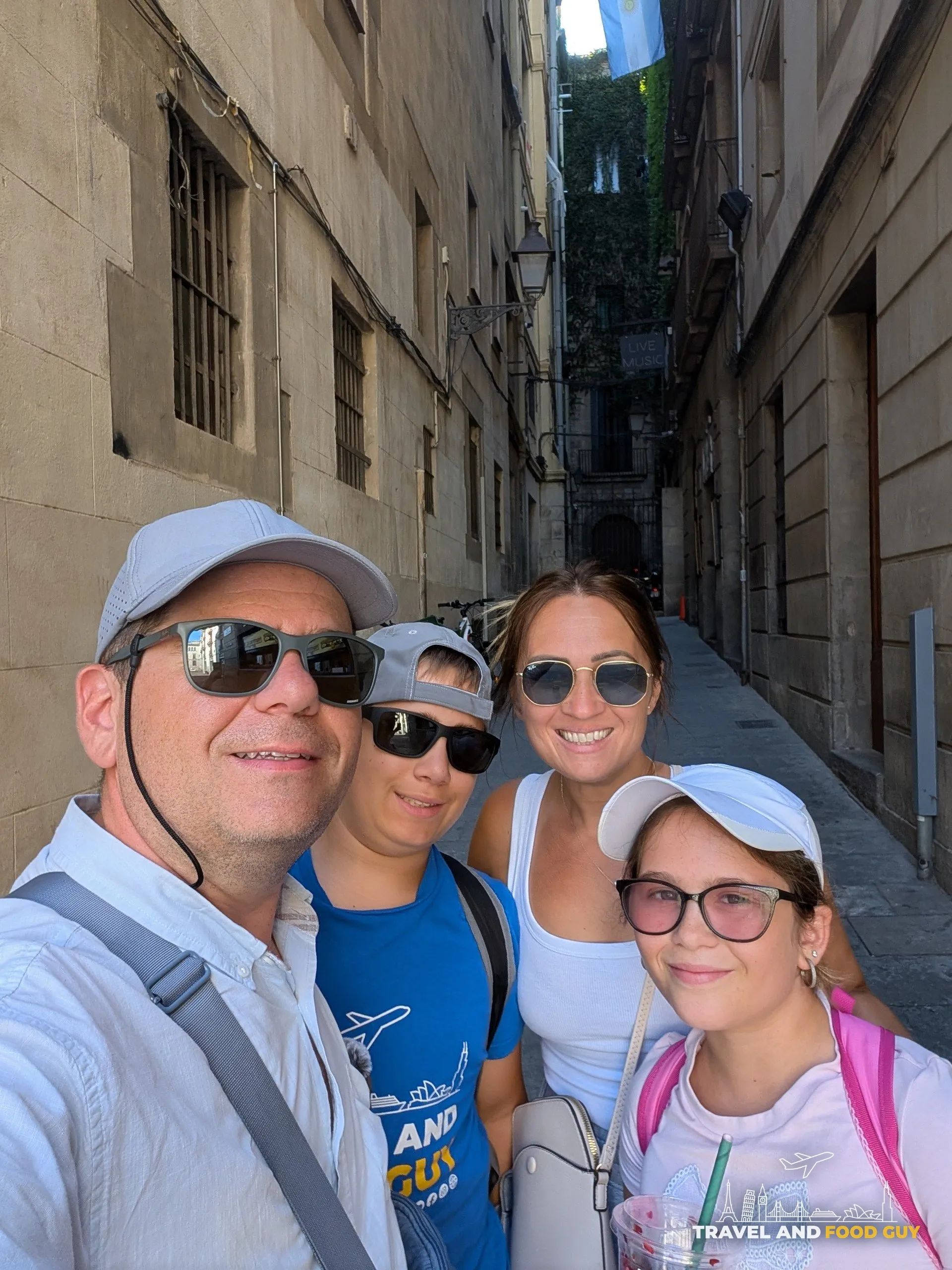
The shade helps more than I expected. We did this in the late afternoon in August, and the lanes stay shaded in a way the open squares in this city very much do not at that hour.
Why Is It Called El Call?
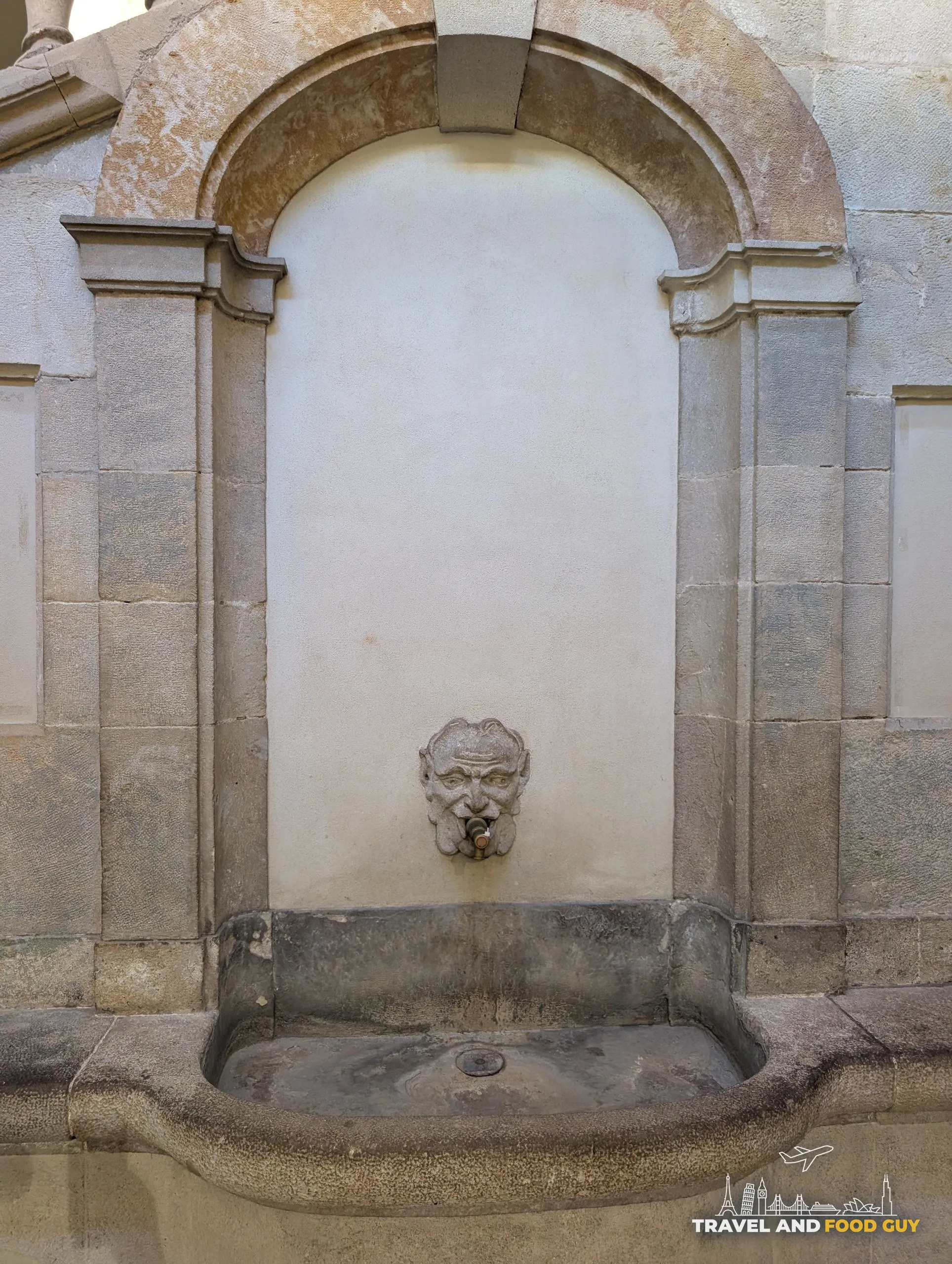
The usual explanation is that call comes from the Hebrew word for community or congregation. There is a competing theory that it comes instead from a Latin word for a narrow lane, which anybody standing in one of these streets would find fairly persuasive. You will see both given confidently, and the quarter is called El Call either way.
El Call and the Gothic Quarter: The Practical Notes
Sinagoga Major del Call
Carrer de Marlet 5, 08002 Barcelona
Five euros per person. No child rate is published
Closed Saturdays. Hours differ between summer and winter, so check on the day
Booking online lets you choose a time slot, and I would book
Not a working congregation. Historic site, small museum and shop
Gelaaati DI MARCO
Carrer de la Llibreteria 7, 08002 Barcelona
Around 5,20 small, around 5,80 medium, some flavours carry a supplement
Ask for the GOLD LINE
Open late, to about midnight
Bathrooms
This is the practical question nobody answers and everybody has. There is a Starbucks directly across from the town hall on Placa Sant Jaume, and its bathrooms are free and clean. We stopped so Emily could get a drink and all four of us used them. In a quarter of narrow lanes and small bars where you are expected to buy something first, it is the easiest stop in the area.
Getting here
Metro Jaume I on the yellow line or Liceu on the green, a short walk from either
The Roman wall, Placa Sant Jaume, the Pont del Bisbe and the cathedral exterior are all free
If you are still working out how to get around the city without spending your holiday on tickets, we went through every option and what it cost us in getting around Barcelona with a family. And if you want the wide view of the city before you go small like this, the tuk tuk tour we did that same morning is the fastest way we have found to cover it. We book most of our tours through Viator, though that particular one we booked direct with the operator.
The Verdict
Do it, and do not do it as a museum visit. The Sinagoga Major is a short stop and five euros and it is genuinely worth both, but it is not the reason to come. The reason to come is that this is one of the oldest corners of the city, it is a few minutes from the most crowded building in it, and you can walk the whole thing in an afternoon for the price of a gelato.
Barcelona is very good at selling you the big attractions. This one it barely mentions, and it is the part I have thought about most since. A quarter that was burned on the fifth of August, a room that spent six hundred years as a warehouse and got filled back up by strangers donating what they had, a Roman wall on an open corner, and a man playing a double bass into a cathedral door.
If you have walked El Call, I want to know whether the Roman wall was on your list before you got there, or whether you just turned a corner into it. Tell me in the comments.